Weekly Roundup – All Things California

Some of us who live in arid parts of the world think about water with a reverence others might find excessive. The water I will draw tomorrow from my tap in Malibu is today crossing the Mojave Desert from the Colorado River, and I like to think about exactly where that water is. —Joan Didion in “Holy Water”

 Photo Credit: dougfelt via Compfight cc

Photo Credit: dougfelt via Compfight cc

I was in California last week where much of the news was focused on the drought.  This article in Grist, one of the most informative I’ve read, clarifies the facts and debunks some of the myths surrounding the water crisis.

Diana Marcum, who recently won a Pulitzer Prize for her reporting on Californians impacted by the drought, puts a face on the crisis in this Los AngelesTimes story about a farmer trying to make a living on a small farm, growing pistachios.  We feel his frustration and pain when he and his wife have to make tough decisions after their water allotment is cut to zero.

But California is not alone.  This article in Business Insider makes clear that many of us, across the country and around the world, will likely face similar water issues in the coming years.

Enough bad news.

 Photo Credit: ms4jah via Compfight cc

Photo Credit: ms4jah via Compfight cc

Imagine seeing one of these birds with its nine-foot wingspan come in for a landing in your backyard. The endangered California condor lives in Arizona and California and is rarely, if ever, seen in New Mexico, but one made its way to Los Alamos (about 30 miles northwest of Santa Fe) last week.  My favorite part of this story in the Santa Fe New Mexican is that the yard belonged to a birding enthusiast who had traveled to the Grand Canyon hoping to see recently released condors with no success. What are the odds one would show up in his yard?

Enjoy your weekend and spend some time outside!


The Whiskey Tree

Always carry a flagon of whiskey in case of snakebite, and furthermore, always carry a small snake.” —W.C. Fields

Victorian Box Tree Photo Credit: Paula Nixon

I admit it. I watched way too many episodes of Cheers in the eighties.  When I called the Southside Spirit House I was certain that Coach or some 2015 version of him would answer the phone.

But I’m getting ahead of myself.  Let me back up.  A few months ago I wrote about trying to identify this tree in San Francisco. I was stumped until Ben at Friends of the Urban Forest (FUF) saw my post and had their arborists look at the photo.  They thought it was a Victorian box tree.  What did I think?

I compared the field guide with my photo and it looked like the same tree, but I wanted to see it again before confirming and completing the online profile for the urban forest map.

It was late in January before I returned, a Tuesday; happy hour was just getting started.  Four twenty-something guys were sharing a pitcher of beer at Southside’s window table.  Trying not to attract their attention, I took a tape measure out of my pocket and eyeballed a spot four feet up from the ground and measured the trunk’s circumference.  Studying the tree, it did appear to be a Victorian box: smooth, gray trunk with narrow, wavy-edged, dark-green leaves. It was covered with buds, all tightly closed.

I wanted to see the creamy white petals and inhale the orange blossom scent, just to be sure it really was a Victorian box, but by the time the blossoms opened I would be back in New Mexico. That’s when I had what I thought was a great idea.

I waited about a week to give the tree time to go into full flower.

The telephone rang and I could picture Coach wiping his hands on a bar towel and  answering, Cliff and Norm looking on over the tops of their beers.  He grumbles a little, but listens and then sets the receiver down on the bar.

He shrugs and says to Sam, “Some nut wants to know what the flowers smell like,” and shuffles across the bar out the door and disappears up the stairs.

But it didn’t happen that way.  The telephone at Southside rang a few times until voice mail picked up with a message advising that they rarely answer the phone or check the messages, best to send an email.

So, I did.  And within a couple of days I received a reply from the manager; she hadn’t noticed any flowers on the tree.

More weeks passed. Back in San Francisco I was impatient to see the tree,   It was blooming, but not showy—lots of small white blossoms nestled in the glossy leaves, smelling faintly of oranges, easy to miss unless you stopped to look and take a deep breath.

Tree #150163, a thirty-foot tall Victorian box, on Howard Street in front of a busy bar quietly does its job intercepting more than 400 gallons of storm water per year (if it rains, that is) and reducing carbon monoxide by 77 pounds.

I’ll lift a glass to that!


Weekly Roundup–Earth Day 2015

Interim
by Lola Ridge

The earth is motionless
And poised in space . . .
A great bird resting in its flight
Between the alley of the stars.
It is the wind’s hour off . . .
The wind has nestled down among the corn . . .
The two speak privately together,
Awaiting the whirr of wings.


Napa County. Photo By: Paula Nixon

Napa County.
Photo By: Paula Nixon

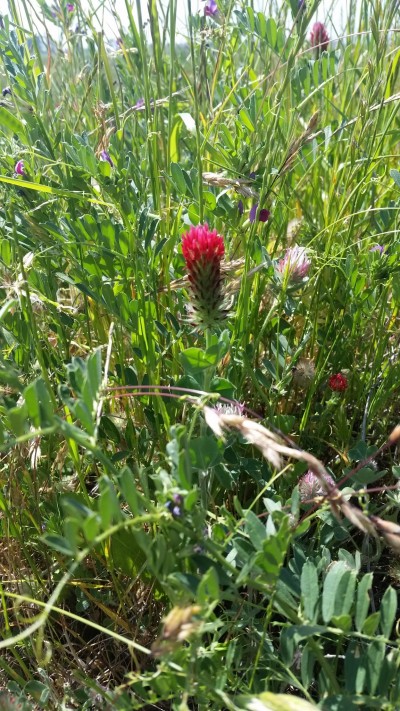
I didn’t spend Earth Day planting a tree or picking up trash, but traveling—from Sacramento to Stockton to San Francisco.  At a stop in Napa County, not in a picturesque vineyard, but in an industrial park where two huge yellow earth movers were silent, finished with their work for the day. A breeze riffled a small field of wild flowers just off the road and a pair of red-winged blackbirds flitted from cattail to fencepost and back again.  I am always amazed at how the natural world carries on, constantly adapting , until it no longer can, to  our improvements and developments.

Back in the car, Earth Day stories filled the airways and newspapers.  A few of my favorites:

This NPR story tells how the day got its name from Julian Koenig, the same adman who came up with  “it takes a licking and keeps on ticking” for Timex watches.  His simple “earth day” was a big improvement over the original “environmental teach-in” or “ecology day”.

On Talk of the Nation, host Neal Conan interviewed Lester Brown, the president of the Earth Policy Institute, about how the politics and focus of Earth Day have shifted over the years.

In the Santa Fe Reporter, this week’s cover story was “Oh, Beehave!” It was encouraging to read about those in New Mexico working to save honeybees after the dire warnings about the collapse of their populations.

Tickle bees are not endangered like honeybees, but this is a fun story with a video out of Portland about ground-nesting bees and an elementary school that has adopted them.

Happy Earth Day!


Weekly Roundup – April 13th – For the Birds

 Photo Credit: nosha via Compfight cc

Photo Credit: nosha via Compfight cc

Watching nesting ospreys in Colorado or eagles in Iowa via a live camera feed is  Better than ‘Survivor’  according to recent a National Public Radio story.   So, it seems I am not alone in my fascination with the birds. Last week when a a line of thunderstorms threatened the Midwest, I kept an eye on the Decorah nest and the weather forecast, picturing baby eagles being tossed from the nest or worse,  but they came through unscathed.

The skies cleared over the weekend and  a viewer who lives much closer than I, drove to the maple tree and spent a few hours watching the nest from her lawn chair.  Her report with pictures is posted on the Raptor Resource Facebook page.

Back at my house I suspect that there is a nest or two nearby, but haven’t walked through the trees to investigate.  From my desk I’ve watched two ladder-backs pecking at the seed cake and two robins sipping at the bath.  They’re regulars, in both cases a male and a female visit daily, but I only see one of each pair at a time.  Last night just before dark the robin with the bright yellow beak and showy red breast (the male)  took a long bath.  Splish, Spash: Why do Birds Take Baths? a post on The Nature Conservancy’s blog attempts to answer the question.

The lovely thing about birds is that we can observe them from almost anywhere, the country, the suburbs, even the middle of the city.  This poem, Eye to Eye with a Hawk, about housework and a raptor on the fire escape, was posted on The New York TImes‘ City Room blog.

Enjoy your week and go outside!

Raptors and Cupcakes

Western Screech Owl Photo By Paula Nixon

Western Screech Owl
Photo By Paula Nixon

Our local Wild Birds Unlimited  celebrated its 22nd anniversary today with cupcakes and a visit from the Santa Fe Raptor Center.

On the sidewalk in front of the store a volunteer from the center told the crowd about this tiny western screech owl that lost an eye in an accident and is a permanent resident at the center.  Most of the birds brought in as rescues are rehabilitated and released, once they have recovered from their injuries (everything from collisions with cars to falling out of the nest.)  The little ones are often fostered by the resident raptors until they are big enough to test their wings.

Inside I ate a chocolate cupcake under the golden gaze of a great horned owl.  She calmly observed the gathering of bird lovers, kids, and shoppers from her perch on the gloved hand of another volunteer. Before leaving to run  the rest of our errands, Dave and I checked out the blackboard with a list of recent sightings in the Santa Fe area.

I could do this every Saturday.

Wild Birds Unlimited Photo By Paula NixonWild Birds Unlimited
Photo By Paula Nixon


Weekly Roundup – April 6th – 12th

Bats in the bedroom? Flickers in the gutter?

7 Gentle Ways to Use a Broom in Spring in the current issue of Orion Magazine tells how to deal with both, plus a few other unwanted visitors.

Female Ladder-Backed Woodpecker Photo Credit: Dave Betzler

Female Ladder-Backed Woodpecker
Photo Credit: Dave Betzler

At my house this week we have woodpeckers at the back patio and eagles in the kitchen via a live feed from Decorah, Iowa.  The third egg hatched last week and the adults are allowing the eaglets, especially the oldest one, a little more time out in the sunshine, but it will still be weeks before they are ready to try their wings.

Today I spotted my first hummingbird of the season at my nectar feeder. According to  Anne Schmauss, in this article in the New Mexican, they arrived right on schedule.  She provides all of the information you need to attract hummers to your backyard.

On a  more serious note there has been lots of news coming out of California the last few days about the ongoing drought and  new restrictions on water use. Drought Tests History of Endless Growth in The New York Times is an in-depth look at the challenges the state faces.

And finally, in celebration of spring and National Poetry Month, a recitation by Tom O’Bedlam of Daffodils by William Wordsworth.

Enjoy your week and let me know if you have seen any hummingbirds in your neighborhood!

Names for the 2014 Mexican Wolf Pups

Scarlett. Dark Fang. Howl. Elpis. Prosperor.*

These are five of the 91 names submitted in the third annual Mexican wolf pup naming contest hosted by Lobos of the Southwest.  Students from kindergarten through eighth grade competed to name 17 pups born in the wild in 2014 (38  were documented in the annual census, but only those captured and collared received names.)

I had the honor of being a judge this year for the first time and spent three days looking at artwork, reading essays, considering names and marvelling at the creativity that went into the entries.  It was a tough job and after submitting my rankings I awaited the results as eagerly, I’m sure, as the students.

Apache_DaisyKThe winning entries—Tempesta, Fuerza, Apache, Pecos, Griselda, Dakotah, Essential, Vida, Century, Atoyaatl, Adero, Survivor, Guardian, Monty, Tiara, Bravery, and Mia Tuk—can all be seen here along with the artwork and essays.

The wolf pups, born in the spring of 2014, will soon be a year old and are almost full grown.  They spent the winter learning to hunt with their families/packs.  Some will stay for another year, helping out with the new pups, but others will start to travel on their own, looking for mates and trying to establish their own territories.

One of my favorite entries is the one pictured above. Apache.  It’s a great name for a wolf, but it’s also a success story in the recovery effort of the Mexican gray wolves, just barely saved from extinction.

Apache, assigned the official studbook number of m1383, is a male wolf born to the  Hawks Nest Pack that runs in Arizona in the Apache-Sitgreaves National Forest.

He is the great grandpup of the original Bluestem Pack alpha female (F521), named Estrella (Spanish for star), by the zookeepers at the Cheyenne Mountain Zoo when she was born in 1997.  She was released into the wild with her mate and pups in 2002 and lived a long and productive life.

One of her daughters (F1042), Apache’s grandmother,  is the current alpha female of the Bluestem Pack.  F1042 had four pups in 2012 that received names in the first naming contest—Huckleberry, Keeper, Little Wild, and Clover.  All have died (two in illegal shootings and one in a routine capture by the field team) except Clover (F1280).

Clover dispersed from her family, the Bluestem Pack, late in 2013, found a mate, and became the alpha female of the Hawks Nest Pack.  Apache was born in her first litter of pups.

I’m keeping my fingers crossed that in two years  I’ll be writing about Apache’s first pups.

*These entries all received honorable mentions.